Showing posts with label BBC. Show all posts

Saturday, 15 February 2014

Preview: The Big Questions in Edinburgh on BBC One, 16/02/14

Nicky Campbell and I share the same home city.
Tomorrow will mark my fourth appearance on the ever popular BBC programme, The Big Questions. Hosted by Edinburgh born Nicky Campbell, the show explores religious, moral and ethical issues where a studio audience take part in the debates that take place.

I keep coming back, because this show has somewhat become a major fixture in the weekly TV schedule and this is also a programme that provides the opportunity for those taking part to come out of their comfort zone and assert their views and opinions. And I'm not just talking about the audience, but I'm also talking about those who comment on the show through social media, blogging or even those who shout at the TV screen.

Most of you will probably be enjoying your Sunday morning sleep (unless you are working early in the morning) whilst I will be in my car driving over the Forth Road Bridge to head to where the show is taking place within the Scottish capital. Without a doubt (and with honesty), I still really wish for the chance to take a seat as one of the main speakers in the front row on the show, but know that I'll have to settle once again for a spot somewhere else in the audience (it's not a bad thing, I'm just being a little too ambitious!).

But then again, I am asking for a little too much by being pushy and no doubt will try to put in a meaningful contribution once again on the programme, particularly on the debate regarding assisted dying which is a topic that has caused much debate here in Scotland. Independent MSP for the Lothians, Margo MacDonald MSP, has recently relaunched proposals to make assisted suicide a legal right for people who are terminally ill.

To conclude, I'll let you know that despite the passionate views many of us will hold under the studio lights and with many people watching, all of us will be friendly enough with one another and feel lucky and honoured to be in the audience. And, on another lighter note, one or two of my friends will be trying to guess what colour of tie I shall be wearing - last year I caused quite a stir with my bright green tie. Should I go for another extravagant colour or just return to a cool blue or purple? Or should I even wear one at all?

You'll have to tune in tomorrow from 10am on BBC One (across the UK) to find out.

Thursday, 23 January 2014

Last night's Nolan Show and Dr Paisley's interview with Eamonn Mallie

I had the absolute pleasure in attending the opening edition of the new series of BBC Northern Ireland's hit television show, The Nolan Show. Some of you may ask why I travelled all the way to Belfast, but others who know me well enough will surely understand.

The Nolan Show is the television version of Stephen Nolan's much listened to radio programme on BBC Radio Ulster and BBC Radio Five Live. The format is specifically tailored to cover the latest current affairs and developments in Northern Ireland and the whole ethos of the programme is to put the viewer and the audience into the heartbeat of the action by e-mailing, telephoning and tweeting in their views. I've commented on the show's format and think it's one of the best across the UK, in my honest opinion.

Many people over the last two Monday nights will have cast their eyes on the recent two part documentary where former First Minister of Northern Ireland, Dr Ian Paisley, was interviewed by Eamonn Mallie. Dr Paisley's comments have sparked a lot of debate and much of last night's programme was dominated by it. I was absolutely gutted to have just missed out on the opportunity to put my view across on the show but, just before I fly across to Wales this morning, I wanted to put my views on the record.

Nobody can deny that Dr Ian Paisley is a major and publicly well known person within Northern Ireland and beyond. In general, as with many well known political and publicly know people I think there is always an inevitability that the person in question will have to speak out or express themselves publicly in reflection of their career and public life. Tony Blair, Nelson Mandela and Margaret Thatcher are just a few examples of people who have expressed themselves in the aftermath of holding public office or a major position in the public eye, whether they have done so through an autobiography or on television, for instance. 

Dr Paisley is well known and, albeit some may deem some of his recent comments as controversial, would it not occur to anybody that at some point he had to express himself publicly, reflecting back on times before? In the aftermath of the last couple of weeks, I would be very intrigued to hear what others like current First Minister, Peter Robinson, say about their time in office and before that also.

The other aspect to this whole discussion is on how history, in fifty years from now if God wills, will view politicians such as Dr Ian Paisley and Peter Robinson. The big ambition for Northern Ireland is to continue to move on from the sad times of the past and to continue to build a prosperous future for the people here. There has been a lot of investment into Belfast, Derry/Londonderry (I was there last September) and all over Northern Ireland and that needs to keep coming in order to sustain it's future. 

Touring Belfast yesterday, I gained an impression and appreciation of the history of the city, significant events that have taken place and where Belfast and Northern Ireland are going for the future. I have no doubt that I will come back again. Walking past many areas of this city, particularly in the city centre, it is almost difficult to imagine the carnage that had taken place here all those years ago during the troubles. I've never felt so safe, secure and welcomed and the people of Belfast and Northern Ireland. It almost felt like I was still back home in Scotland. The people here in Northern Ireland have a lot to be proud of about today and the future.

Friday, 5 April 2013

Has the new look BBC News overtaken Sky?


The original BBC Broadcasting House in central London.
It was only last month when the BBC News Channel was aesthetically revamped and, more significantly, relocated over four miles east from the BBC Television Centre at Wood Lane to the newly revamped BBC Broadcasting House near Oxford Circus.

Yet the transformation of the television news output from the BBC has been very clear to see. The new set doesn't feel so isolated any longer. The previous set in the west of London was frankly dull and very boring. The new set gives me, the viewer, an impression that there is some form of activity definitely taking place in what is now the "biggest newsroom in Europe". The news has livened up at the BBC once again.

As far as the content is concerned, not much has changed apart from the fact that a brand new extended newspaper review programme has been introduced nightly at 10:30pm and 11:30pm.

There is no doubt that the newsroom at Broadcasting House is absolutely enormous. Every hour, the channel takes deep pride in showing off it's brand new facilities to the whole nation, showing journalists and other BBC News staff concentrating deeply on their computer screens, quite probably researching content for the news, editing footage for news packages and doing other related activities.

I was lucky to go and see the building for myself at this time last year. Sadly, it wasn't fully operational but there's no doubt that I will want to head down south again to go and see the place being brought to full life. Nevertheless, the part of visiting Broadcasting House now that excites me the most is that anyone can actually watch the news as it broadcasts live from the public café.

Sky News underwent a slight revamp it it's on screen graphics nearly three years ago. Yet it's own set remained more or less the same. I've also noticed that Sky News has become less interactive than before prompting the question - is it time for Sky to play catch up with the BBC once again as far as news output is concerned?

Sunday, 27 January 2013

Why won't you promise us an EU referendum of our own, Alex and Nicola?

Source: Scottish Government (Flickr)
Lets be hypothetical for a second. Fast forward to eighteen months time and imagine that the Yes Scotland camp have won the independence referendum. 

David Cameron has, despite much criticism yet at the same time credit, offered the United Kingdom a referendum on the European Union after no doubt much pressure from his own backbenchers. The only thing is it isn't until 2017 which will undoubtedly create an aroma of uncertainty. And what if the Conservatives do not win the next election? There are still many ambiguities that are yet to resolve themselves.

But lets rewind back to this weekend. Ireland's Europe Minister, Lucinda Creighton TD, reportedly stated on Friday that an independent Scotland would have to apply for membership of the European Union and that the process of doing so would be "lengthy".

Fiona Hyslop MSP confirmed Lucinda Creighton TD wrote an e-mail to the Deputy First Minister, Nicola Sturgeon MSP, which emerged on the Scottish Government's Scottish Referendum website and in the press, with Andrew Kerr on Sunday Politics Scotland, accusing the BBC of "misconstruing" the Irish Minister's position before the programme replayed the interview with Dublin South East's Teachta Dàla.

I think rather than the SNP continuously assert that an independent Scotland would continue to play a role in the European Union, why don't they take a leaf out of David Cameron's book? After all, Scotland's view of the European Union isn't that different compared to the rest of the United Kingdom, as figures from a recent poll featured in a Guardian article late last year suggests.

Why can't Alex Salmond and Nicola Sturgeon surrender their will to the people of Scotland and come out and propose a Scottish referendum on the European Union straight after the independence referendum, if Scotland votes for independence?

Switzerland have a direct democracy model which has really put democracy into the heart of society and the role of the citizen. Republic of Ireland have referendums on a regular basis. An independent Scotland shouldn't shy from such a model of democracy. The citizen should have the final say, not the politician.

The First Minister continuously speaks about the 'community of the realm' and its about time he continued to be a full time defender of this philosophy on every issue, including on our future in the European Union.

Saturday, 26 January 2013

What defines us as Scots?

Scotland is a small country in the north of Europe. Yet we are big people despite having just over 5 million inhabitants across our land. But on the weekend of the birthday of our national bard, Robert Burns, one may ask themselves this fundamentally intriguing question: what defines us as Scots?

And after making two contributions on BBC Radio Scotland's Big Debate with the ever canny Brian Taylor (how I love that Scots word), the answer, to me, is clearly not just a single one. The audience was diverse - we had indigenous Scots, Jamaican Scots, Middle Eastern or Arab Scots (such as myself), and Scots who were born or even brought up in another part of the UK such as England. Beyond that you have many other types of Scot who either live here or abroad. This diversity defines us.

The previous contributor early on in the debate (14:07) spoke about our nation being the best little nation on earth. His point was fantastic and illustrated what makes Scotland such a diverse yet united nation. I unapologetically went one step further and, with glee, described our nation as the "greatest nation on earth" (15:10). "No swagger here whatsoever", Brian Taylor declared but I went on to substantiate my point.

In all seriousness I really do believe we are the greatest nation on this planet because of this diversity. Any person can read Burns poetry. Any person can read Scots. Any person can put a saltire around their torso and wave it at Hampden Park or Murrayfield. There is no such thing as a "them and us" attitude up here because its not Scottish and it confronts our values as a people and nation. And whether you went to a faith, grammar, private or state school or whatever your ethnic or religious background, everyone is in the team and everyone counts. We are a canny people and take a broad minded view of life and the world around us and express ourselves so eloquently in many different ways, whether we are happy or sad.

And even abroad, look no further than the United States. Scotland isn't just a nation of 5 million people. There are at least five times more Scots in America, either by birth or ancestry and thankfully more and more people are tracing their ancestry to our country. Mitt Romney, who ran for the United States Presidency in November 2012, is technically one of ours because of his ancestry.

To put it simply, wherever you go, Scottishness is everywhere.

But what about recent times? Later on in the programme I put the question out into the open air asking whether regaining our Scottish Parliament or even the controversial years when Margaret Thatcher was British Prime Minister had increased our awareness and desire to defend and preserve Scottish culture (32:45)? Brian cleverly turned the direction of the question onto me.

There is no doubt that those periods in history let the genie of Scottish national aspiration out of the bottle. They were wake up calls. Now I'm not taking a stance on the Scottish independence debate here but events such as these provoked strong feeling and it isn't even thinkable to suppress those feelings, rather its actually an unhealthy thing to do. I don't think I've seen Scottish culture celebrated as much as now and I wonder if clinging on to our heritage is defining our politics today. The Yes side for Scottish independence may be way behind at the moment but who knows? Remember Liverpool beating AC Milan in Turkey nearly eight years ago?

And even events in our own personal lives can release our own genies from our own bottles. Like in my case, for instance, when I moved south to England on two occasions. Don't get me wrong, being in England was a extraordinary learning experience and in many ways enjoyable as well, particularly with regards to travelling around the nation of St George.

But you don't really realise what you've got until you leave. And once you do then you are desperate to come back and not just stay here, but contribute more than ever to Scottish society. That's certainly the case with me and, as I found out yesterday, many other people.

To finish off, I want to quote the current Irish President, Michael D. Higgins from his Christmas message last month where he said:

"As our economy has contracted in recent times, many people are feeling the consequences, in terms of employment or income. However, our economic condition does not, on its own, define who we are."

The same applies north of the border.

Alba gu bràth.

Sunday, 20 January 2013

REVIEW: BBC's The Big Questions in Glasgow, January 2013

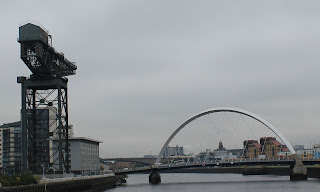
Glasgow's Clyde Arc
Well can you believe it? Today marked probably my dozenth ever appearance on a television screen. You couldn't make it up!

The BBC hit show, The Big Questions, is produced by Mentorn Scotland and came to one of Scotland's most prestigious schools - Hutchesons' Grammar School, located in the south of Glasgow. Back for its sixth series, the show continues to be a successful hit with viewers across the UK and is full of lively, and sometimes, controversial debate.

After being full of nerves and being unable to sleep until nearly 1am this morning, I woke up just before 6am, beautifying myself before making my way to appear on BBC One this morning. Backstage in the waiting room I went on to my second cup of tea of the day and it was hardly just past 8am. But what I loved about today was how incredibly friendly everyone was. There's a strange yet sweet sense that we're all like a little family.

Because lets be honest the size of the audience on the programme isn't actually that big. We're talking about approximately 50 people (count the number when you watch the show), a crew of about 15-20 people including producers, the directors, researchers, studio runners and of course the ever canny Nicky Campbell.

After a briefing from Nicky and his colleagues we then had a warm up debate to get us all going. Particularly regarding the fact that it was bitterly cold outside so having a more than warm studio was much welcome.

10am, showtime! Hyped up and ready to go, there is no doubt that nobody can say that I was anything less than excitable. Clapping vigorously like a crazy football fan watching his team winning 5-0, the lights, music and the atmosphere were enough to overwhelm myself inside. And I say that being passionately interested in broadcasting.

To my surprise, even to this minute, Nicky was brave enough to let me speak on not one but two occasions. Firstly, by accident. Scottish Conservative leader Ruth Davidson MSP made one of the best points of the show when she said that successful male role models shouldn't be the alpha male stereotype but instead courteous, polite gentlemen.

I agreed with that so much that I went "hear, hear" and it provoked Nicky to turn the microphone onto myself. Rather than writing my opinion of what I said on here, I'd rather you saw it for yourself (from 29:00) but what I will say is - chivalry rules.

And then my second contribution (from 47:15) was regarding whether it should be legal to get high. Now when I watched this back earlier this afternoon, I cringed. I have to admit it wasn't my finest hour at the dispatch box.

However, it wasn't completely bad. But, on the negative side, I would have rather used the word "preparations" and not "stuff" and actually wish I had answered Nicky's last question more directly. My adrenaline rush took control and drove me in the wrong direction when it came to getting the right words out. A learning experience gained I think.

On a separate note from the running of the show, I wanted to clear one or two things up from the show. I have to admit I'm a little uncomfortable with the idea of pharmacies supplying "legal highs" because I think it sends the wrong message to the public. We are responsible healthcare professionals and frankly we are talking about substances like cocaine, ecstasy and even LSD - they are extremely dangerous.

I was very intrigued to hear from all the other contributors about the issue and can completely understand their points. However, I still think the bottom line is - these substances are intoxicating and can have some extremely serious negative effects for an individual and their health.

But of course, on another separate note, there are drug rehabilitation programmes involving methadone dispensing in pharmacy, permitted under the Misuse of Drugs Act 1971, where patients are normally monitored on their level of consumption and then work is done to ensure that they can reduce their need and dose until they are drug free.

We should all aim to eliminate the problems that illicit drugs cause and I strongly support well co-ordinated rehabilitation programmes in the NHS and healthcare plus education as well, particularly for our young people. But that does not mean the law should be liberalised to a degree where it sends out the wrong message to people about drugs.

However, I was relieved to have made the point outlining a pharmacist's responsibilities and opening up in saying that there is a lot of debate going on in pharmacy and beyond regarding addiction to over the counter medicines.

Overall, it was well worth travelling on a 100 mile round journey to Glasgow and back to be on the show. I absolutely loved it. Being on such programmes, getting involved in the broadcasting industry and championing pharmacy's cause is what wakes me up in the morning.